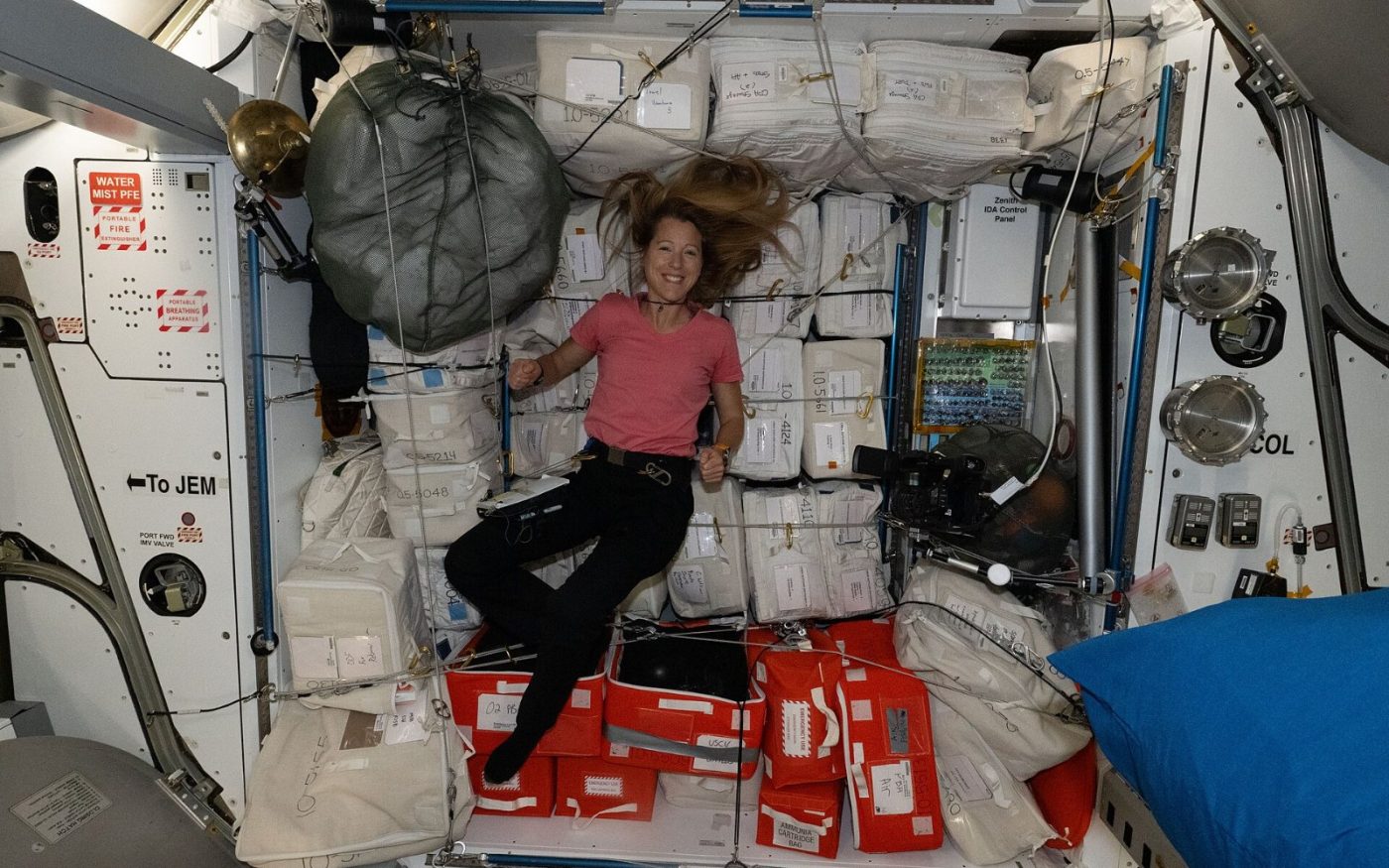
French astronaut Sophie Adenot of the European Space Agency returned to Earth on 8 October 2026 after 237 days in orbit, setting a new European record for the longest single spaceflight. Her SpaceX Dragon capsule splashed down off the coast of Los Angeles at 11:34 a.m. EDT (15:34 GMT), and she arrived back in Europe two days later, on 10 October, at ESA’s European Astronaut Centre in Cologne, Germany.
What happened
Adenot flew as part of NASA’s SpaceX Crew-12 alongside NASA astronauts Jessica Meir and Jack Hathaway and Roscosmos cosmonaut Andrei Fedyaev. The crew undocked from the International Space Station on 7 October at 12:05 GMT and spent about 27 and a half hours flying home before the capsule landed in the Pacific, NASA reported.
After medical checks on the recovery ship, Adenot was flown to Houston and then, on 9 October, to Germany aboard a French Air and Space Force Airbus A330 tanker-transport. According to ESA’s release, she landed in Cologne at 04:21 GMT on 10 October and will spend two to three weeks readapting to gravity at the :envihab research facility run by the German Aerospace Center (DLR), next to the astronaut centre.
ESA Director General Josef Aschbacher welcomed her back, saying she had “embodied our values through her successful mission”, and used the occasion to argue that “Europe must secure a role in exploration commensurate with its political and economic weight”.
Records and milestones
The mission, which ESA named εpsilon (epsilon), lasted 237 days, 5 hours and 18 minutes. That beats the previous European record held by Italy’s Luca Parmitano by more than 35 days, and it also makes Crew-12 the longest SpaceX Dragon mission so far, overtaking the 235 days logged by Crew-8.
During the flight Adenot made three spacewalks within 14 days, spending a total of 19 hours and 42 minutes outside the station. She became the first French woman to walk in space and only the second European woman to do so, after Italy’s Samantha Cristoforetti. It was her first trip to space; Hathaway was also a first-time flyer, while Meir’s cumulative total rose to 440 days, placing her among NASA’s top ten.
Key facts
- Launch: 13 February 2026 from Cape Canaveral Space Force Station, Florida.
- Splashdown: 8 October 2026, 15:34 GMT, Pacific Ocean off Los Angeles.
- Return to Europe: 10 October 2026, European Astronaut Centre, Cologne.
- Duration: 237 days, 5 hours, 18 minutes — a European single-flight record.
- Science: about 218 hours of work on 35 European experiments, plus roughly 25 hours maintaining or upgrading ESA systems in the Columbus laboratory.
- Technology tests: included the European E4D exercise device and in-orbit metal 3D printing.
- Outreach: ESA says her school activities reached more than 290,000 pupils, including through CNES’s ChlorISS plant-growth experiment run with around 4,000 schools.
Background
Adenot, a French Air and Space Force helicopter test pilot, was selected in ESA’s 2022 astronaut class, the first new intake in more than a decade. Europe has no crew vehicle of its own, so its astronauts reach the station through barter agreements with NASA, flying on US commercial spacecraft in exchange for European contributions such as the Columbus module and service modules for NASA’s Orion capsule.
The research programme on εpsilon spanned human physiology, materials science, biology, fluid physics and radiation studies. ESA says all experiments proposed by France’s space agency CNES and all ESA-assigned experiments were completed.
Analysis: why it matters
Beyond the record, longer European stays generate exactly the kind of data that future deep-space missions need: how bodies, equipment and procedures hold up over many months. Tests such as the compact E4D exercise machine and metal printing in orbit are aimed squarely at spacecraft that will have less room and less resupply than the ISS.
The timing also matters politically. Within two weeks of her return, ESA’s governing Council met in Paris on 21–22 October to prepare an intermediate ministerial meeting in Rome on 15 December, where member states will discuss the Director General’s proposal on “Europe’s Future in Space Exploration”, covering low Earth orbit, the Moon and Mars, according to the agency’s Council summary. With the ISS expected to be retired around the end of the decade, Europe has to decide how much it wants to pay for its own access to space versus continuing to buy seats from partners. High-profile missions like Adenot’s are a reminder of what is at stake in that choice: visibility, scientific return and a voice in how the next generation of stations and lunar missions is designed.
Sources
- ESA — ESA astronaut Sophie Adenot returns from her first mission to the International Space Station
- NASA — NASA’s SpaceX Crew-12 Dragon splashes down
- ESA — Sophie Adenot is back on Earth
- ESA — Key outcomes of the 350th ESA Council meeting
- Malay Mail (AFP) — ‘No divisions, no borders’: French astronaut Sophie Adenot on seeing Earth from space