Japan’s space agency JAXA launched its Martian Moons eXploration (MMX) spacecraft on 19 October 2026 at 19:41 GMT (04:41 on 20 October, Japan time), sending the probe on a roughly ten-month cruise to Mars. If the mission works as planned, it will become the first spacecraft to orbit Phobos, the first to scoop material from the surface of a Martian moon, and the first to bring anything back to Earth from the Mars system, with a capsule due to land in Australia in 2031.
What happened
The spacecraft lifted off on an H3 rocket, the tenth flight of Japan’s new flagship launcher, from the Yoshinobu Launch Complex at the Tanegashima Space Center in Kagoshima Prefecture. JAXA had announced the date and time in August, with a reserve window running to 7 November in case of delays; in the end the rocket flew on the first scheduled attempt.
According to Space.com’s launch coverage, the four solid boosters dropped away about two minutes into the flight and the upper stage later performed a burn of a little over six minutes to push the probe onto a trajectory toward Mars. MMX separated from the rocket roughly 71 minutes after liftoff. Jiji Press, via Nippon.com, reported that the probe reached its planned orbit and that, after three successful flights in a row, the H3’s overall success rate now stands at 80 percent.
The European Space Agency, a partner on the mission, congratulated JAXA in a statement. ESA’s project scientist for MMX, Elliot Sefton-Nash, said the H3 launcher had “performed fantastically to send MMX onward to Mars”.
The mission plan
MMX is scheduled to arrive at Mars in August 2027. Its propulsion module will then settle into a so-called quasi-satellite orbit around Phobos, an unusual path that keeps the spacecraft close to the small moon as both circle Mars. The probe is expected to spend about three years in the Mars system, first mapping Phobos to pick safe and scientifically rewarding landing sites, then touching down twice to collect samples. Flybys of Deimos, the smaller and more distant of Mars’s two moons, are planned for the final months before the spacecraft heads home in November 2030.
The target is a modest amount of material — about 10 grams — but that would be enough for detailed laboratory work on Earth. A small rover named IDEFIX, built jointly by France’s CNES and Germany’s DLR, is due to be deployed onto Phobos in late 2028 or early 2029 to study the surface before the main spacecraft lands.
Key facts
- Launch: 19 October 2026, 19:41 GMT (20 October, 04:41 JST), H3 flight No. 10, Tanegashima Space Center.
- Arrival at Mars: planned for August 2027, after a cruise of about ten months.
- Sampling: two touchdowns on Phobos, aiming to return roughly 10 grams of surface material.
- Return: departure from Mars in November 2030; sample capsule landing in Australia in 2031.
- Partners: JAXA leads, with NASA, CNES, DLR and ESA contributing hardware, instruments or ground support.
- NASA’s share: the MEGANE gamma-ray and neutron spectrometer built by Johns Hopkins APL, a pneumatic sampler from Honeybee Robotics, and Deep Space Network support; NASA is entitled to at least 15% of the returned sample, according to Space.com.
- ESA’s share: deep-space communication equipment on the spacecraft and tracking through its Estrack ground station network.
Background
MMX is JAXA’s third sample-return mission, following the Hayabusa and Hayabusa2 asteroid missions, the second of which delivered material from asteroid Ryugu in 2020. It builds on that experience but adds the challenge of operating deep in the gravity well of a planet. The only previous attempt to reach Phobos with a lander, Russia’s Phobos-Grunt in 2011, never left Earth orbit and fell into the Pacific Ocean in early 2012.
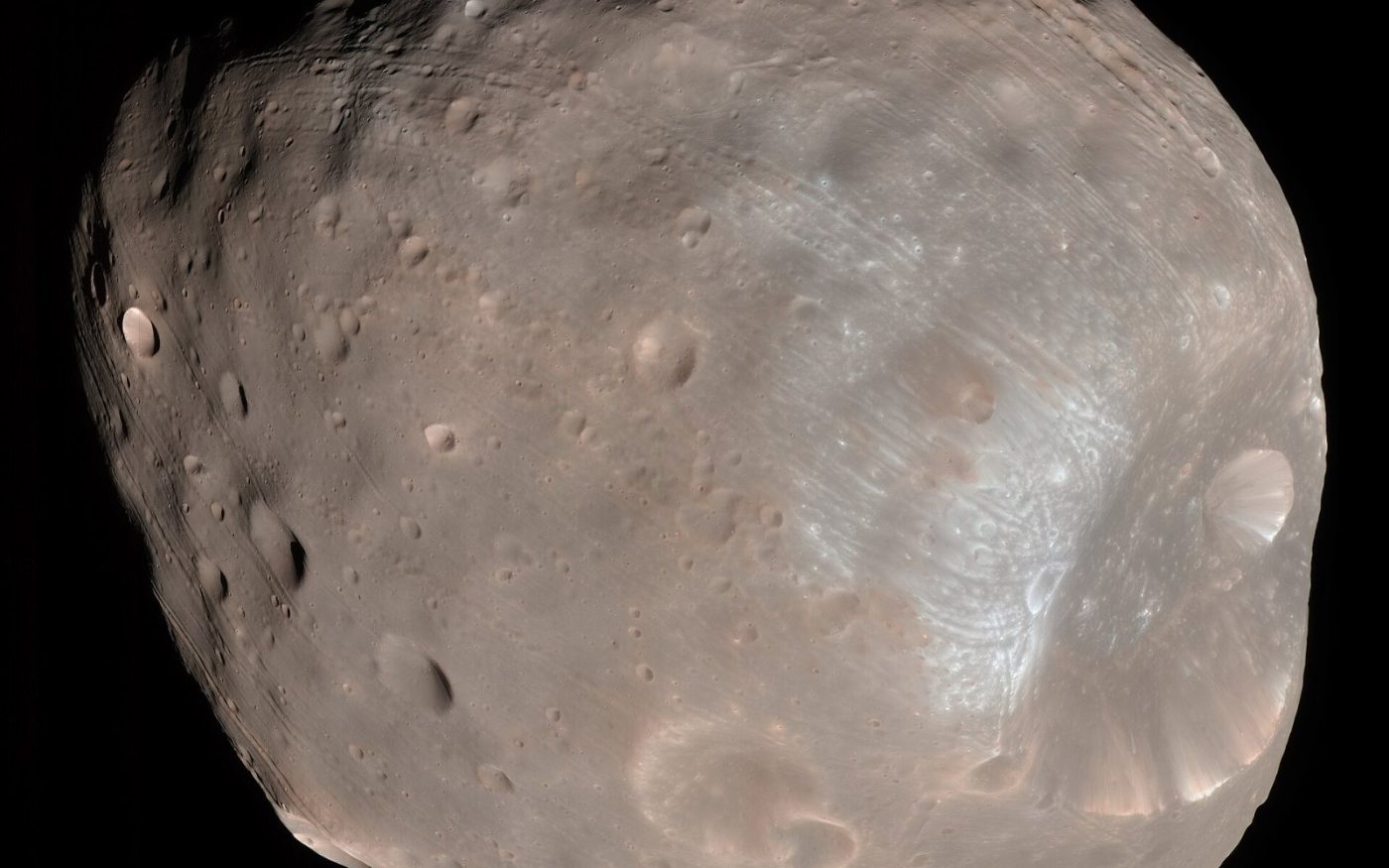
Phobos is a dark, lumpy body only about 27 kilometres across at its widest. Scientists have debated for decades whether it and Deimos are asteroids captured by Mars’s gravity or fragments thrown up by a giant impact on the planet, which would mean they are partly made of Martian material.
Analysis: why it matters
The scientific prize is a direct answer to the origin question. If the returned grains look like primitive asteroid material, that would point to capture; if they match Martian rock chemistry, it would favour the impact theory and also offer a cheap sample of Mars itself, since Phobos is thought to have collected debris blasted off the planet over billions of years. Either result would sharpen models of how rocky planets and their moons formed.
There is also a strategic dimension. With the joint NASA–ESA Mars Sample Return programme under heavy budget pressure, a Japanese-led mission could deliver the first material from the Mars system to laboratories on Earth. For Japan, a clean H3 launch on a high-profile interplanetary flight helps rebuild confidence in a rocket whose early record included failures, and strengthens the country’s position as a partner of choice for international deep-space projects. The hard part, however, still lies ahead: orbit insertion, two landings on a low-gravity moon and a return trip spanning several more years.
Sources
- ESA — MMX lifts off to Mars’s moon Phobos
- JAXA — Launch schedule of MMX aboard H3 F10 (press release, 20 Aug 2026)
- Space.com — Japan launches historic MMX sample-return mission to Mars’ moon Phobos
- Nippon.com (Jiji Press) — Japan Successfully Launches Rocket with Martian Moon Probe
- SpacePolicyOnline — What’s Happening in Space Policy October 18-24, 2026