China’s economy expanded by 4.5% year on year in the third quarter of 2026, according to data published by the National Bureau of Statistics (NBS) on Monday, 19 October 2026. The reading was a modest pick-up from 4.3% in the April–June quarter and came in ahead of most analysts’ forecasts, but the same release showed household spending and investment remaining weak while exports carried much of the load.
What happened
The NBS said gross domestic product for July to September reached 37,536.7 billion yuan at current prices. On a seasonally adjusted basis, output grew 1.2% from the previous quarter, up from 0.9% in the second quarter. Across the first nine months of the year, GDP totalled 107,107.1 billion yuan, a rise of 4.6% on the same period of 2025.
Alongside the growth figures, the statistics bureau published its monthly activity data for September. Industrial value added rose 5.5% year on year in September, while retail sales of consumer goods, the main gauge of consumer spending, grew just 1.1% to 4,243.3 billion yuan. Fixed-asset investment for January to September was 7.2% lower than a year earlier, and real estate development investment fell 20.6% over the same period.
In its statement on the data, the bureau described the economy as generally stable but cautioned that “the foundation for steady economic growth still needs to be consolidated,” adding that the international environment remained complex and volatile.
Key figures
- Q3 2026 GDP growth: 4.5% year on year (Q2: 4.3%; Q1: 5.0%)
- Quarter-on-quarter growth (seasonally adjusted): 1.2% in Q3, after 0.9% in Q2 and 1.3% in Q1
- January–September GDP: 107,107.1 billion yuan, up 4.6%
- Industrial value added, September: up 5.5% (January–September: up 5.3%)
- Retail sales, September: 4,243.3 billion yuan, up 1.1%
- Fixed-asset investment, January–September: 33,411.5 billion yuan, down 7.2%
- Real estate development investment, January–September: down 20.6%
- Exports, January–September: 23,197.9 billion yuan, up 16.4%; imports 16,742.0 billion yuan, up 22.3%
- Surveyed urban unemployment rate, September: 5.2%
- Producer prices, September: up 5.0% year on year (January–September: up 2.3%)
- Per capita disposable income, January–September: 34,230 yuan, up 5.3% in nominal terms and 4.4% in real terms
Where growth came from
The preliminary GDP accounts show a sharply uneven picture by sector. Services, which account for the largest share of output, grew 5.2% in the third quarter, while the secondary sector (industry and construction) grew 3.4%. Within that, manufacturing expanded 5.9%, but construction contracted 4.4%. Real estate value added slipped 0.4%.
The fastest-growing parts of the economy were in technology and business services: information transmission, software and IT services grew 9.8% in the quarter, and leasing and business services grew 12.9%. Hotels and catering rose 6.3%, and transport, storage and post 5.9%.
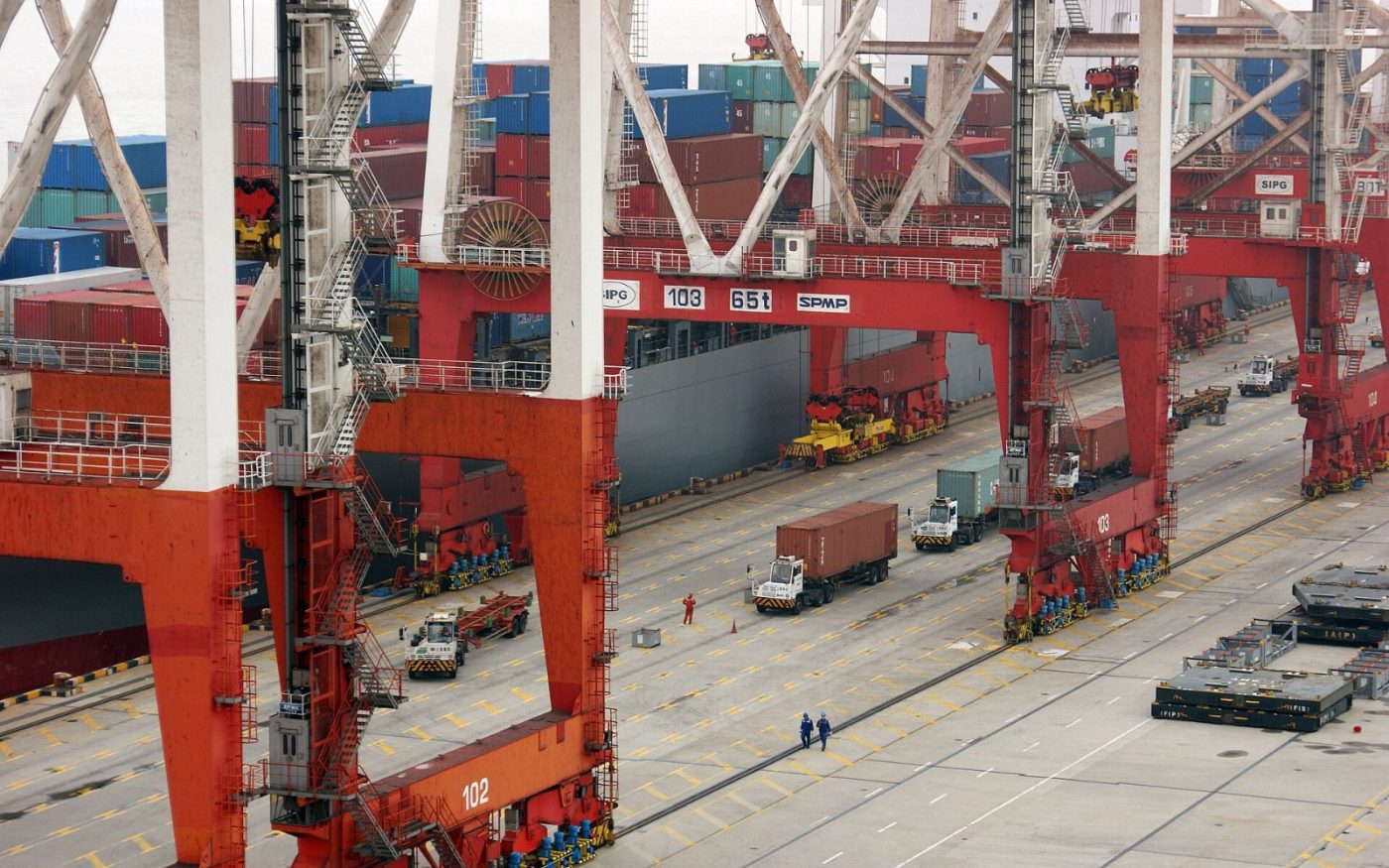
Trade was a major driver. Exports measured in yuan were up 16.4% in the first nine months, which Al Jazeera reported was driven largely by demand for semiconductors and other technology-related goods. Imports grew even faster, at 22.3%, a rise that is likely to reflect, at least in part, higher prices for imported energy and other commodities.
Background
Beijing has set a 2026 growth target range of 4.5% to 5%, according to Al Jazeera, and the South China Morning Post reported that the third-quarter reading keeps the economy on track to meet it. Nine-month growth of 4.6% sits within that band.
The property sector has been contracting for several years, weighing on construction, local government land revenues and household wealth. The September data offered little sign of a turnaround: real estate investment remained deeply negative and construction output shrank. Price data also shifted noticeably. Consumer prices rose 0.9% over the first nine months, but producer prices, which had been falling for much of the past few years, were 5.0% higher in September than a year earlier, a swing that coincides with higher global energy costs linked to conflict in the Middle East.
Analysis: what it means
The headline number is good enough for policymakers to claim the economy is on target, but its composition points to a familiar imbalance. Factory output and exports are running well ahead of domestic consumption: industrial production grew five times faster than retail sales in September. That leaves growth dependent on foreign demand at a time when global growth is expected to slow under the weight of higher energy prices.
The steep fall in fixed-asset investment is the most striking weakness. With property investment down by about a fifth, the drag from real estate is large enough to offset gains in manufacturing and infrastructure. Household income is still growing in real terms, at 4.4%, yet that has not translated into stronger retail spending, suggesting consumers remain cautious about jobs and asset values.
The rise in producer prices may ease concerns about deflation in the industrial sector and could support corporate profits in some upstream industries. However, if it is driven mainly by imported energy costs rather than stronger demand, it could squeeze margins for manufacturers further down the supply chain who struggle to pass costs on to consumers.
For the final quarter, attention will turn to whether Beijing adds fiscal or monetary support to shore up domestic demand, or whether it accepts growth near the bottom of its target range. The NBS’s own wording, that the foundations of growth still need consolidating, signals that officials see the recovery as incomplete.
Sources
- National Bureau of Statistics of China — National Economy was Generally Stable with New Achievement Made in High-Quality Development in the First Three Quarters (19 October 2026)
- National Bureau of Statistics of China — Preliminary Accounting Results of GDP for the Third Quarter of 2026
- Al Jazeera — China’s economy grows 4.5 percent in Q3, beating forecasts
- South China Morning Post — China’s economy grows 4.5% in third quarter, staying on track for annual target